
The Mission to Disable the Sandy Hook Lighthouse
by Michael Adelberg
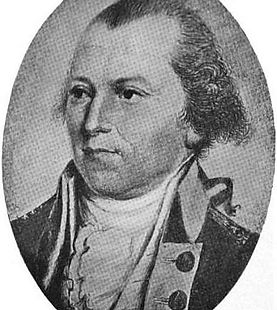
Maj. William Malcolm of New York was dispatched to Monmouth County to disable the Sandy Hook Lighthouse. He was accompanied by Col. George Taylor of Middletown.
- March 1776 -
In early 1776, American leaders learned that the British were preparing to invade New York. The lighthouse at Sandy Hook, including its keeper, Adam Dobbs, and its pilot, William Dobbs (brothers), played important roles in guiding British ships into New York Harbor. They had already stopped at least one British ship from reaching New York. While the Sandy Hook lighthouse was a great source of pride for Americans, sober leaders understood that it now had to be disabled.
On March 4, the New York Provincial Congress dispatched Major William Malcolm to New Jersey to disable the lighthouse. His orders read:
You will endeavor to take the glass out of the lantern, and save it if possible; but if you find it impracticable, you will break the glass. You will endeavor to pump the oil out of the cisterns into the casks and bring it off; if you should be obstructed in your task by the enemy, you will pump it on the ground. In short, you will use your best discretion to render the Light House entirely useless.
Malcolm’s complete order is in the appendix of this article. He landed at Middletown on March 7 and met with Middletown’s Committee of Observation. He was soon joined by Colonel George Taylor, the township’s senior militia officer. Malcolm and Taylor reached the light house on March 8 and acted. The New York Provincial Congress recorded:
Mr. Hobert informed the Congress that Major [William] Malcom, who was sent to dismantle the light-house, was returned and had executed that matter effectually, with the assistance of Col. George Taylor and some of his men; that Major Malcom found it impossible to take out and save the glass, as well as for want of tools as by reason of the time necessary for that purpose, and was therefore obliged to break it; that Major Malcom had delivered the lamps and oil, two tacklet falls and blocks, removed from the light-house to Col. George Taylor and taken receipt for the same, which was read and file.
Colonel Taylor was left with the taken items, and he provided Major Malcolm with a receipt:
Received from William Malcom eight copper lamps, two tackle falls and blocks and three casks, and a part of a cask of oil, being articles brought from the light-house on Sandy; Hook;, and which I will deliver to him, or to the order of the Provincial Congress of the Colony of New- York, when called for. – George Taylor, Colonel
On March 12, the New York Provincial Congress reported to George Washington about the Malcolm-Taylor mission:
Major Malcolm, who was sent to dismantle the Light-House, he was returned and had executed the matter effectively, with the assistance of Col. George Taylor and some of his men; that Maj. Malcolm found it impossible to take out and save the glass, for want of tools and by reason of the time necessary for that purpose, and was therefore obliged to break it; that Major Malcolm had delivered the lamps and oil, two tackle falls and blocks, removed from the Light House, to Col. George Taylor and taken receipt of the same.
A week later, the New York Provincial Congress asked Taylor to deliver the oil to Malcolm, which was presumably done. But Taylor remained in possession of the hardware taken from the lighthouse. Curiously, no surviving document about this action mentions Sandy Hook’s resident pilot, William Dobbs, his brother and lighthouse keeper, Adam Dobbs, their servant, or the boats at Sandy Hook maintained to row out to ocean-going vessels in need of his guidance.
At first blush, the Malcolm-Taylor expedition achieved its objective without any difficulties. But, based on future events, the expedition can only be regarded as a failure. While they had the chance to truly cripple the lighthouse, Malcolm and Taylor only removed a handful of replaceable parts and supplies, and they apparently did nothing to the pilot house, outbuildings, or boats that were all necessary to stationing men on Sandy Hook. Perhaps the timidness was because the Americans envisioned using Sandy Hook for their own purposes soon again or perhaps they were reluctant to destroy American property. Either way, the Malcolm-Taylor mission was not sufficiently destructive.
Only one month later, the British Navy landed on Sandy Hook and occupied it for the rest of the war—the British would hold Sandy Hook into 1784, longer than any other piece of the rebelling Thirteen Colonies. The light house remained unusable at least through the end of April. The British constructed a beacon 1,000 yards from the lighthouse and burned fires nightly until the light house was repaired. A naval officer at Sandy Hook wrote on April 29 that "the lantern was totally destroyed by the Rebels on the 10th of March, which rendered the Light House useless to navigation."
The lighthouse was in reasonable repair by the time the British invasion fleet arrived at the end of June. An attempt to drive the British from Sandy Hook failed. George Taylor, who would turn Loyalist toward the end of 1776, returned the taken hardware to Sandy Hook later that year.
Related Historic Site: Sandy Hook Lighthouse
Appendix: William Malcolm’s Orders to Disable the Sandy Hook Lighthouse
To Major Malcolm: SIR-The Provincial Congress of this Colony having appointed us a committee to concert measures for carrying into execution their resolve of the 5th inst. for the dis- mantling the light-house at Sandy-Hook; we, reposing especial trust and confidence in your abilities and zeal in the common cause, have made choice of you for the execution of that important enterprise. We enclose you a certified copy of the resolve for the purpose, and desire you will conform, as nearly as may be, to the strict letter thereof. You will please call upon the committee of Middletown, or such other place in New Jersey as you shall judge proper, for the assistance you think necessary. Upon your arrival at Sandy Hook, you will endeavour to take the glass out of the lantern and save it if possible; but if you find it impracticable you will break all the glass. You will also endeavour to pump the oil out of the cisterns into casks and bring it off; but you should be obstructed by the enemy, or not be able to procure casks, you will pump it on the ground. In short, you will use your best discretion to render the light-house entirely useless. –Pierre Van Cortlandt, Abraham Lott, John Sloss Hobart
Sources: Anonymous, "Sandy Hook Light-House," American Historical Record, vol. 3, 1874, p 510-1; William James Morgan, Naval Documents of the American Revolution (Washington, DC: US Government Printing Office, 1969) vol. 4, pp. 194-5; William James Morgan, Naval Documents of the American Revolution (Washington, DC: US Government Printing Office, 1969) vol. 4, pp. 307-8; Convention, Committee of Safety and Council of Safety of the state of New-York : 1775-1777, 2 vols., (Albany : Thurlow Weed, printer to the State, 1842) v. 1, item 348, 354, and 367; Lopez, John. “Sandy Hook Lighthouse.” The Keeper's Log, Winter, 1986, p 5; Peter Force, American Archives, v6: 1416.